Before you pack another bulky beach towel, discover why Turkish beach towels have become the go-to choice for travelers, beach lovers, and design enthusiasts worldwide. Lightweight, stylish, and surprisingly absorbent, these centuries-old towels offer modern performance without the bulk.
Imagine stepping onto sun-warmed sand with a towel that feels like silk against your skin, absorbs water in seconds, and dries before you reach your beach chair. This isn’t fantasy—it’s the everyday reality of authentic Turkish beach towels, weaving centuries of Anatolian craftsmanship into every luxurious thread.
Lighter than air, softer with every wash, and steeped in centuries of craftsmanship—discover why Turkish beach towels are changing how the world dries off.
Turkish Beach Towel Origins & History
Turkish beach towels trace their roots to the Ottoman Empire’s hammams (public baths), where thick, absorbent cotton cloths were used for centuries. These towels weren’t just practical—they were symbols of hospitality and luxury. Fast forward to the 19th century, when European travelers discovered these fethiye cloths during their voyages to the Aegean coast. By the mid-20th century, Turkish cotton towels began gaining global popularity, especially in Europe and the US, celebrated for their lightweight elegance and superior absorbency.
Today, they’re a global phenomenon, blending Turkish heritage with contemporary coastal living. Fun fact: The term “Turkish towel” was coined by Western travelers who mistook the towels’ origin for Turkey, though they’re woven across Anatolia and the Mediterranean. The “Turkish beach towel” isn’t just a product – it’s a legacy of craftsmanship carried forward into modern luxury.
Over time the peshtemal evolved from a purely functional bath garment into a versatile textile used worldwide as a beach towel, sarong, picnic blanket, shawl, and decorative throw. Contemporary Turkish towels blend ancestral weaving techniques with modern yarns and dyes, preserving cultural craftsmanship while meeting global consumer needs.
What Turkish Beach Towels Are Made Of
Turkish beach towels are typically made from natural fibers—most commonly:
- 100% Turkish cotton — prized for its long staple fibers that create soft, absorbent, and durable yarns.
- Linen blends — sometimes blended with cotton for extra texture and breezy feel.
- Bamboo or bamboo-cotton blends — for eco-friendly and antimicrobial properties.
- Modal or rayon blends — occasionally used for extra softness and drape.
Key material characteristics:
- Long-staple fibers create stronger yarns that pill less and soften over time.
- Low pile or flat weave reduces bulk and speeds drying.
- Natural dyes or reactive dyes for better colorfastness.
Why it matters: Synthetic blends (e.g., polyester blends) trap moisture, cause odors, and degrade faster. Pure Turkish cotton releases water quickly—keeping you dry and fresh.
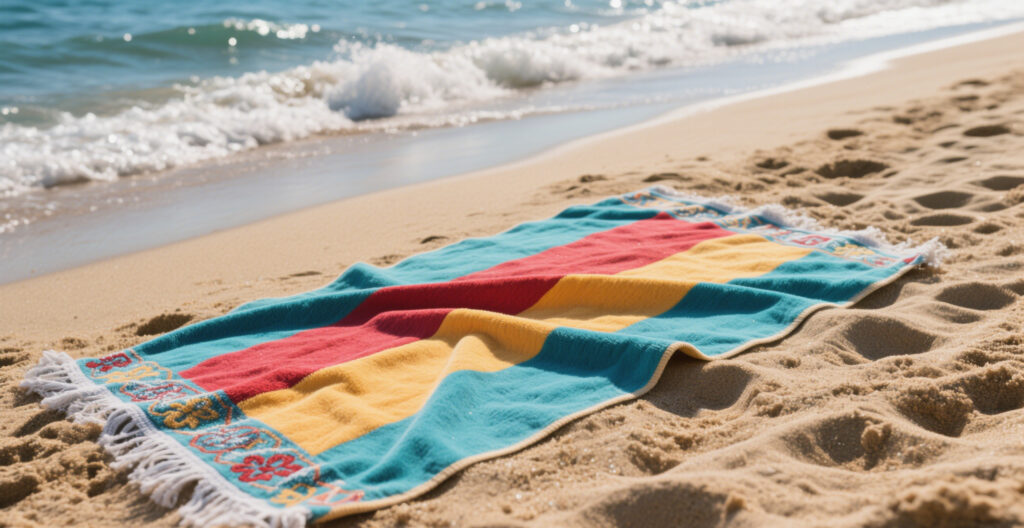
How Turkish Beach Towels Are Made
Creating a genuine Turkish beach towel is a blend of ancient artistry and precision. Here’s the process:
- Fiber selection: Suppliers select long-staple cotton or blended fibers for strength and absorbency.
- Spinning: Fibers are spun into yarn; spinning quality influences softness and durability.
- Warping & weaving: Yarns are arranged on looms. Peshtemals use plain, twill, or decorative weave patterns; many are woven on shuttle or power looms depending on scale.
- Finishing: Towels are washed, sometimes enzyme-treated, or mercerized to increase luster and absorbency.
- Fringing/hemming: The traditional peshtemal often features hand-twisted or knotted fringe at the ends.
- Dyeing & printing: Towels are dyed (piece-dyed or yarn-dyed) and may receive reactive dyes for better colorfastness.
- Quality control & packing: Final inspection, fold/pack, and labeling.
This method produces a towel that’s inherently lighter, thinner, and more absorbent than a bulky terry towel – all without sacrificing strength.
Quality Control steps Beach Towel Manufacturers Follow
To guarantee the luxury experience, reputable Beach Towel Manufacturers implement rigorous QC checks:
- Incoming fiber inspection: checks fiber length, cleanliness, and moisture.
- Yarn tensile testing: ensures yarn strength and evenness.
- Weave uniformity checks: during production to avoid thin spots or uneven tension.
- Colorfastness tests: wash and light exposure tests verify dyes resist fading and bleeding.
- Absorbency & drying tests: sample towels are tested for grams of water absorbed per gram of material and drying time.
- Pilling & abrasion resistance tests: simulate long-term use.
- Fringe & hem durability tests: stress tests for tassel strength and seam integrity.
- Final visual inspection: for defects, sizing, and labeling accuracy.
No reputable china towel manufacturer would cut corners in this area. Quality control is paramount; it is the cornerstone of a beach towel’s quality commitment.
Turkish Beach Towel Key Features & Performance
What makes Turkish towels attractive—especially for beach and travel use—are these key features:
- Ultra-lightweight & compact: folds small for suitcases and beach bags.
- High absorbency: despite being thin, high-quality long-staple cotton absorbs water efficiently.
- Fast-drying: flat weave loses water faster than fluffy terry loops, reducing mildew risk.
- Softness that improves with washing: fibers relax and the towel becomes silkier with use.
- Durable & long-lasting: properly made towels resist fraying and pilling.
- Versatility: works as towel, sarong, throw, picnic mat, baby blanket, and scarf.
- Aesthetic designs: stripes, geometric patterns, and fringed ends make them fashionable.
Performance metrics to look for (when shopping):
- GSM (grams per square meter): typically 200–400 for Turkish beach towels — lighter weight means faster drying.
- Absorbency measurement and drying time (if provided).
- Colorfastness ratings.
Why do travelers and luxury seekers swear by Turkish beach towels? Here’s the performance breakdown:
| Feature | Turkish Beach Towel | Regular Terry Beach Towel |
|---|---|---|
| Weight | Lightweight (350-450 GSM) | Heavy (600+ GSM) |
| Absorbency | Extremely Fast (3x faster) | Slower, holds water longer |
| Drying Time | 15-30 mins (sun-dries fast) | 2+ hours (stays damp) |
| Thickness | Thin & Flexible (rolls small) | Bulky & stiff |
| Durability | Lasts Years (strong fibers) | Wears out faster (short fibers) |
| Softness | Silky, Plush (long fibers) | Coarse, scratchy (often) |
| Best For | Beach, Travel, Yoga, Home | Casual home use (not ideal for travel) |
This isn’t marketing fluff – it’s the tangible difference in how the towel feels and functions.

Turkish Beach Towel vs. Regular Terry Beach Towel
Short comparison summary: Turkish towels are lightweight, compact, and fast-drying; terry towels (looped cotton) are thicker, plush, and feel plusher for home-bath use.
| Attribute | Turkish Beach Towel (Peshtemal) | Regular Terry Towel |
|---|---|---|
| Weight / Bulk | Low — packs flat | High — bulky |
| Drying Speed | Fast | Slower |
| Absorbency | High relative to weight | High overall (more water held) |
| Warmth | Less insulating | More insulating |
| Compactness for travel | Excellent | Poor |
| Softness | Softens over uses | Immediately plush (higher GSM) |
| Style & design | Decorative, fringed | Usually plain hems |
| Uses | Beach, travel, wrap, decor | Bath, spa, home use |
Buying guidance: choose Turkish towels for travel, beaches, and multi-use lifestyle needs; choose terry for home-bath experiences where plush comfort and water-holding capacity matter most.
Turkish Beach Towel Common Uses
Beyond the beach, these towels shine in every corner of your life:
- Beach & Pool: The original use – dries fast, lightweight, easy to carry, doesn’t get heavy when wet.
- Travel: Fits into a carry-on, dries quickly in hotel rooms, doubles as a blanket or wrap.
- Yoga & Pilates: Soft, non-slip surface for mats, absorbs sweat instantly.
- Home Spa & Bath: Luxurious alternative to bath towels – dries fast, feels amazing.
- Picnics & Outdoor Events: Light, easy to pack, perfect for grass or sand.
- Fashion Accessory: Worn as a sarong, head wrap, or even a stylish throw on a couch.
- Gifts: Hand-embroidered designs make them stunning presents.
- Sarong or cover-up: stylish wrap for beachwear.
- Home throw or decorative textile: used on sofas or beds for layered styling.
- Promotional/brand items or hospitality linen: hotels and boutique spas favor peshtemals for minimalist luxury.
This versatility is why they’re a staple in modern travel and wellness routines.
Pro tip: Many travelers use them as “beach to street” wraps—drape over shoulders for a chic, effortless look.
Choosing the Best Turkish Beach Towel
When selecting a Turkish beach towel, consider:
Material & weave
- 100% long-staple Turkish cotton for best softness and strength.
- Linen blends for texture and faster drying in humid climates.
GSM & weight
- Lower GSM (200–300) = lighter and faster-drying (good for travel).
- Higher GSM (300–400) = more substantial, more absorbent but heavier.
Size
- Standard beach size: ~90 × 170 cm (35 × 67 in) — check exact brand specs.
- Oversize options exist for couples or full-body wrap.
Finish & fringe
- Hand-knotted fringe signals artisanal finishing.
- Hem quality: reinforced hems add longevity.
Dye & pattern
- Reactive dyes and yarn-dyed stripes are more colorfast.
- Light colors may show stains; darker or patterned towels hide wear.
Certifications
- OEKO-TEX or GOTS for organic/chemical-free textiles.
- Fair-trade or artisan cooperatives for ethical sourcing.
Price vs value
- Very cheap towels may use low-quality cotton and lose softness quickly.
- Mid to premium price points often reflect better cotton and finishing.
Choosing a trustworthy beach towel supplier can save you time. A high-quality beach towel provides better protection for your beach trip.
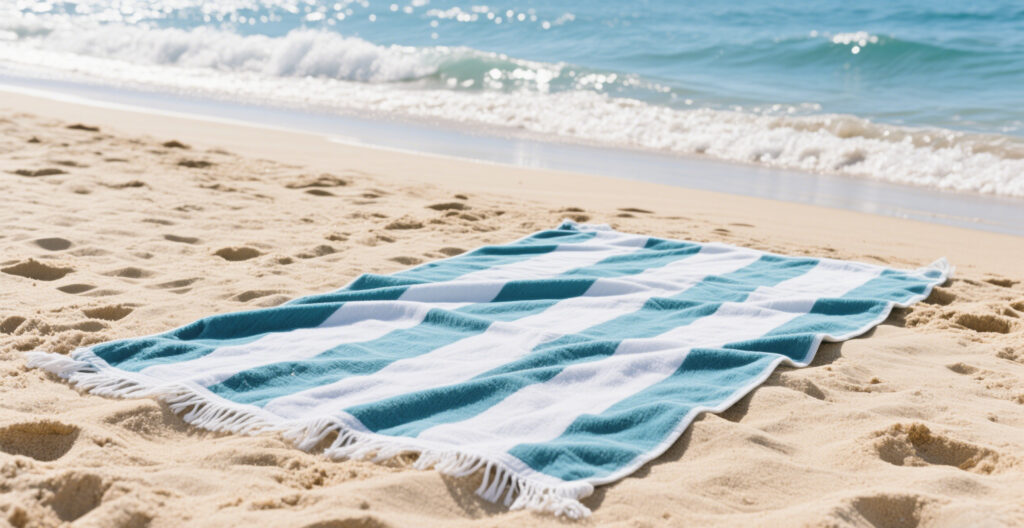
Care tips for Turkish Beach Towels
Proper care helps your Turkish beach towels perform long-term:
- Initial wash: wash before first use to remove manufacturing residues and increase absorbency.
- Wash in Cold Water: Hot water weakens fibers. Use a gentle cycle.
- Avoid Fabric Softeners: They coat fibers, reducing absorbency. Use vinegar (1/2 cup) as a natural softener instead.
- Skip the Dryer: Air dry completely – tumble drying can cause shrinkage and pilling. Hang it in the sun for a fresh scent!
- Don’t Overload the Washer: Wash alone or with similar fabrics to prevent snagging.
- Rinse After Saltwater/Swimming: Chlorine and salt can damage fibers. Rinse with fresh water immediately.
- Fringe care: gently detangle by hand; avoid high-heat tumbling which can fray knots.
- Store Dry: Never store damp. Fold and store in a cool, dry place.
- No Bleach: It degrades cotton fibers. Use oxygen-based bleach only if absolutely necessary.
- Stain treatment: treat promptly with a gentle stain remover; test on a small area first.
Eco-care tip: line-drying in the sun naturally whitens and sanitizes without chemicals, but prolonged sunlight may fade dyes — alternate direct sun with shaded drying.
Frequently Asked Questions (FAQs)
A Turkish beach towel (often called a peshtemal or hammam towel) is flat-woven from long-staple Turkish cotton, making it lightweight, thin, and highly absorbent. Its quick-drying, compact design and decorative fringed edges set it apart from bulky terry towels — ideal for travel, beach use, and as a stylish beach blanket.
For many users, yes. Because Turkish beach towels are thin, quick-drying, and packable, they outperform bulky terry towels for portability and drying speed. Their flat weave also makes them comfortable as a beach blanket and easy to shake free of debris. (Best for sunbathing, travel, and quick post-swim drying.)
Sand tends to stick less to flat-woven Turkish towels than to looped terry cloth. The smooth peshtemal weave lets most sand fall off when shaken; brushing or a quick shake usually removes remaining grains. For minimal sand retention, choose tightly woven Turkish cotton and shake off before folding.
Use it as a lightweight beach blanket, bath towel, sarong, picnic cloth, or travel towel. Lay it flat for sunbathing, wrap it around your waist as a sarong, or pat dry after swimming — its multi-purpose nature (beach towel, hammam towel, travel towel) makes it versatile for seaside and everyday use.
Yes — despite their thin profile, quality Turkish towels made from long-staple cotton are highly absorbent and can dry you efficiently. Their flat weave soaks water quickly and releases it when wrung; for maximum absorbency, look for towels labeled “100% Turkish cotton” or “long-staple cotton.”
Properly cared for, Turkish towels should not retain odors. Their quick-drying nature reduces mildew risk; however, like all towels, they can develop smells if stored damp.
Shrinkage is usually minimal but depends on the cotton type and wash method — expect small amounts (commonly around 2–5%) if washed in hot water or tumble-dried on high.